
Don't see yours? Start with a conversation.
Talk to an AI expertCrunch-IS in numbers
- 170+
- experts
- 120+
- delivered projects
- 40+
- active customers
- 6+
- locations
- 8+
- years of experience

Home / GCP Migration Services
GCP Migration Services

Challenges We Solve

Infrastructure That Won't Scale
Adding capacity means buying hardware, coordinating maintenance, and reacting to demand as it arrives. Business decisions slow when infrastructure can’t keep up.

Downtime Risk at Cutover
A production outage caused by a migration is hard to explain to leadership, customers, or both. Even a short disruption erodes confidence in the process and the team.

Security Drift During Transition
When infrastructure changes quickly, access controls and monitoring fall out of sync. Misconfigurations from a rushed migration can stay undetected long after cutover.

Uncontrolled Cloud Spend
Duplicate environments, idle test workloads, and unclear resource ownership push costs up faster than expected. Without visibility from the start, cloud bills climb before migration is complete.
Benefits of GCP Migration Services

Stop planning around server capacity and start planning around demand. Cloud infrastructure scales with the business — up when traffic grows, back when it drops.

Google Cloud migration services open access to managed tooling that reduces operational overhead — freeing engineering teams to focus on development, not maintenance.

Permissions, environments, and workloads are structured for accountability. Everything is visible, auditable, and owned.

Once in Google Cloud, adding analytics tools, automation, or additional cloud services is straightforward. Migration is a starting point.
Ready to plan your GCP migration? Schedule a strategy session now.
What We Do

Migration Strategy Design
We assess each workload to determine the best migration approach (what moves as-is, what needs adjustment, and in what order), balancing performance, scalability, and risk.

Server Migration
We move servers with dependency checks, pre-migration test runs, and performance validation for the GCP environment. Workloads go live only after they’re confirmed stable.

Data Migration
Data moves to Google Cloud in controlled stages. Each batch is validated for accuracy and accessibility before the next begins. Nothing moves forward until the previous stage is confirmed clean.

Application Migration to GCP
Applications transition to GCP incrementally. Performance and stability are tested before any final cutover — so nothing gets promoted to production until it’s ready.

Post-Migration Stabilization
After cutover, we run a structured stabilization period — monitoring workload behavior, confirming security controls, and resolving issues before they compound. We stay engaged until the environment is stable under real production load.
Our Capabilities
Phased Migration Planning
We define workload migration sequencing based on dependencies, risk, and business continuity requirements — producing a migration plan that teams can execute predictably across multiple environments.
Hybrid and Multi-Cloud Transitions
We migrate from on-premises systems, other cloud providers, or mixed environments — aligning everything to Google Cloud architecture standards while maintaining service continuity throughout.
Google Kubernetes Engine Deployment
For containerized workloads, we implement and configure GKE environments — handling cluster design, networking, and workload placement for managed Kubernetes at scale.
Identity and Access Governance
IAM roles, project segmentation, and access controls are defined from the start, structured intentionally to reduce security exposure and keep permission structures auditable.
Post-Migration Cost and Performance Tuning
After cutover, we monitor workload behavior and resource usage, adjusting configurations before inefficiencies take root. Cloud spend is reviewed against actual usage.
Cloud Services Integration
We connect migrated workloads to Google Cloud managed services — BigQuery, Cloud SQL, Pub/Sub, and others — so teams can use cloud-native capabilities without rebuilding their architecture.
What You Get

Architecture Built on Your Workloads
Every migration recommendation reflects your actual infrastructure — dependencies, performance characteristics, and security posture.

Engineers Who Execute
Our team runs migrations end-to-end. The engineers who design the migration plan are the ones who execute it.

Risk Reduction at Every Stage
Each phase is validated before the next begins. Continuity checks, dependency mapping, and staged cutovers are built into the process.
What Our Clients Say About Us
They come up with lots of scalable and best-practice ideas that enable us to achieve what we have right now.

Crunch-IS was great at leading us on what good should look like and bringing our ideas to life for evaluation and review.

Crunch-IS impressed me with is the quality of developers. It is simply much better than in any other company we’ve tried working with.

We are impressed with their performance, how they are engaged with product development, and how they care about the product.

It’s been a very enjoyable experience. All has been fantastic about communicating, and working.

Our partnership with Crunch-IS has been an invaluable resource as we’ve scaled.

What I found in Crunch-IS was the technical competency, ability to think outside the box, and very good English.

They have a large impact on the whole architecture we ended up with. Overall, I’ve been pleased and impressed with everything Crunch-IS did for us.

Crunch-IS impressed us with their technical excellence and the sheer ‘meeting of minds and cultures’ and open, honest exchanges. This was not a decision we took lightly, and 5 months into the engagement we continue to be really impressed with how Crunch-IS approach the collaboration, and we’re delighted with the calibre of the team we have working with us.

Working with Crunch-IS was easy. They were patient with us as we worked through the contract questions and patient again as we were getting our billing set up. The design work was elegant and the developer delivered the app we had contracted for on time and good quality.

The team at Crunch-IS was very nice to work with. They worked diligently and were very professional. When questions or technical problems arose, they answered them quickly and were always ready and kind about helping us.

Crunch-IS developer helped us deliver an important feature for our project much faster than expected.

Crunch-IS facilitated a seamless, collaborative effort throughout the project. The team maintained open lines of communication, kept detailed records of task assignments, and adhered to project timelines. Their expertise regarding both design and development sets the company apart.

Crunch-IS provides ongoing development support that meets project requirements as needed. Despite their offshore location, they are easy to work with and accessible through communication channels

The best vendor we could possibly find. Crunch-IS blends practical development with innovative design principals. Internal and external feedback to app development has been positive. They complete project milestones by the planned schedule and deliver within budget. The team’s responsive and willing to engage in productive dialogue.

Crunch-IS exceeded my expectations. I appreciated the developers’ resourcefulness in the face of constraints and complex requirements. The company able to deliver and complete the project successfully.

The project has gone smoothly so far. Crunch-IS has an exceptional work ethic. Consequentially, they’ve been able to tackle every challenge that comes their way. They manage day-to-day work on their own well but also communicate with us regularly to make sure we’re on the same page.

The app Crunch-IS worked on is clean, streamlined, and functions as intended. Crunch-IS goes above and beyond to ensure that both teams are in tune. The passionate team crafts an enjoyable experience through their positive demeanor and effective project management skills. The team was very friendly, and working with them was a pleasure.

Why Crunch-IS

Workload-Level Migration Planning
We assess each application and data source individually before anything moves. That assessment drives sequencing, risk decisions, and the choice between lift-and-shift, re-platforming, or targeted modernization.

Risk-First Execution
Cutovers happen only after validation. Rollback paths, dependency checks, and phased promotion are built into every migration, protecting production stability throughout.

Transparent Throughout
You know what’s moving, when, and why. Trade-offs are explained before decisions are made. There are no surprises at cutover.
FAQs
Why do most companies migrate to Google Cloud?
Most companies migrate to remove limitations. The drivers are usually aging hardware that’s expensive to maintain, scaling constraints that require physical capacity decisions, and operational overhead that grows faster than the business. Google Cloud removes the infrastructure ownership burden and replaces it with managed services that scale with demand.
How long does a GCP migration take?
It depends on two things: what you’re moving, and how you’re moving it. A rehost migration — lift-and-shift with minimal changes — can be completed in weeks for a small environment. A replatforming or refactoring effort that restructures applications to use cloud-native services like GKE can take months.
What are the costs associated with migrating to Google Cloud?
Migration costs span three phases: pre-migration assessment and planning, execution, and ongoing cloud usage once you’re live.
The execution phase is where budgets most often get underestimated — on-premises infrastructure stays running while GCP is being brought up, and that overlap period means you’re paying for both simultaneously.
Post-migration, the main cost lever is rightsizing. Resources migrated at their original on-premises scale are rarely optimized for the cloud. GCP applies Sustained Use Discounts automatically for consistent workloads; Committed Use Discounts reduce costs further for predictable ones. The gap between list price and a well-configured environment is significant — but only if sizing is done deliberately.
What is Google Kubernetes Engine (GKE)?
GKE is Google Cloud’s managed Kubernetes service. It lets teams run containerized applications without managing the orchestration layer themselves — simplifying scaling and improving deployment consistency across environments. Not every workload benefits from containerization. We implement GKE only where it adds operational value.
What are the GCP migration strategies?
Google Cloud documentation defines four primary paths.
Rehost (lift-and-shift) moves workloads to GCP with minimal changes — the fastest option, and the right choice when a workload runs fine as-is or can’t be modified.
Replatform makes targeted adjustments to leverage managed services — for example, migrating a self-managed database to Cloud SQL — without changing the application architecture.
Refactor and re-architect go further: modifying how applications work to leverage cloud-native capabilities like GKE or serverless, improving scalability, and reducing long-term operational overhead.
We assess each workload individually and assign a strategy based on its dependencies, architecture, and your post-migration plans.
Crunch-IS Success Stories
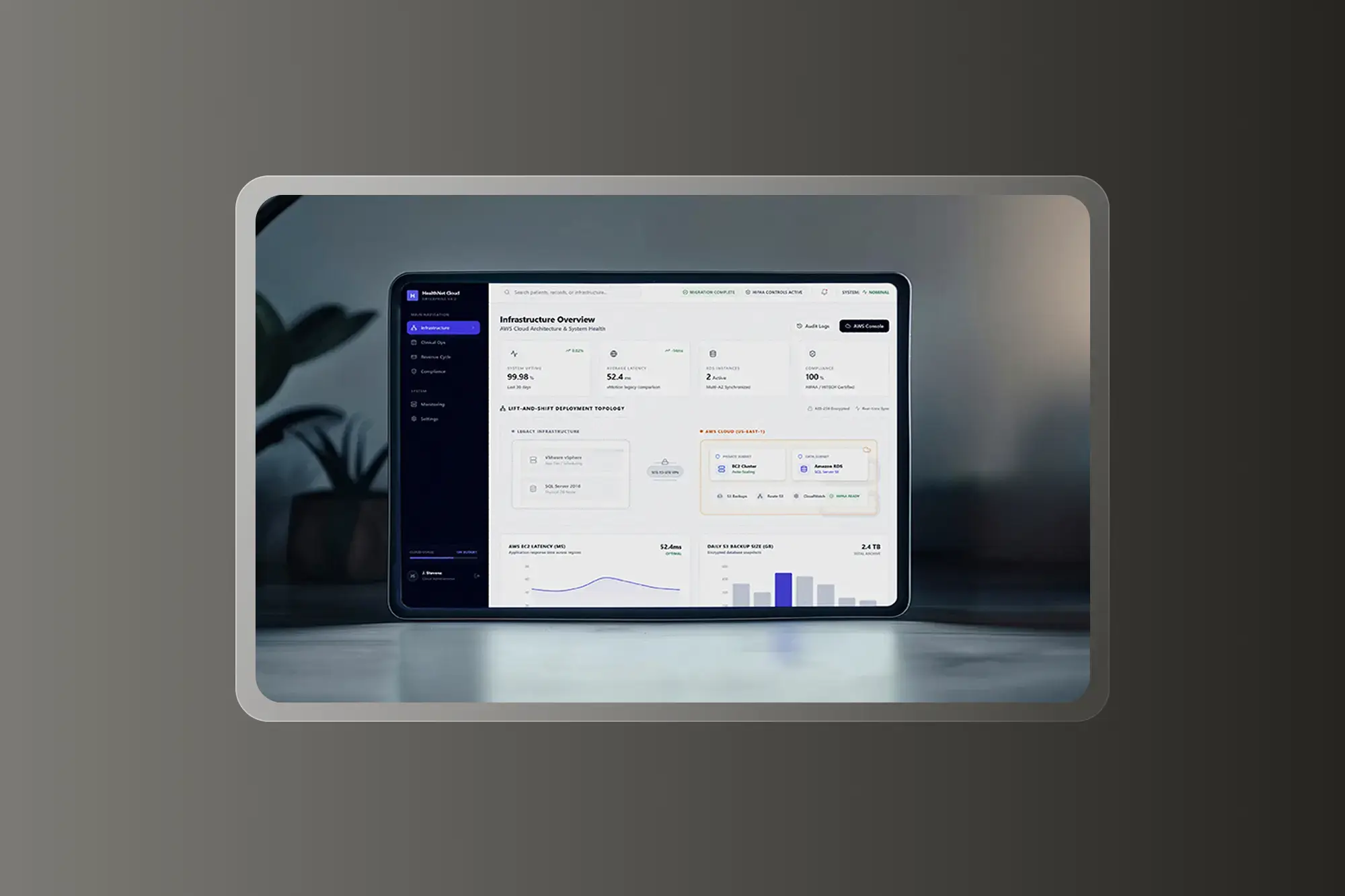
A fast, low-risk cloud migration that reduced operational risk and improved availability...

A data-driven SaaS healthcare platform that optimizes patient management, financial tracking, and...
Tell Us What You’re Building
Send an outline, a spec, or three sentences about where the system has stopped. One conversation is usually enough to know whether we’re the right fit.
Custom software, AI & ML, data and analytics, cloud, and security — from early scoping to long-term delivery.
- 170+ experts
- 120+ delivered projects
- 97% fully satisfied


