
Don't see yours? Start with a conversation.
Talk to an AI expertCrunch-IS in numbers
- 170+
- experts
- 120+
- delivered projects
- 40+
- active customers
- 6+
- locations
- 8+
- years of experience

Home / Digital Battery Passport Solutions and Accelerator for EU Compliance
Custom Digital Battery Passport Solutions and Accelerator for EU Compliance
The EU Battery Regulation mandates a Digital Battery Passport for every qualifying battery placed on the EU market — enforcement starts February 18, 2027.
Crunch-IS is an AI-applied engineering partner that designs, builds, and integrates custom Digital Battery Passport solutions into your existing tech stack using a pre-engineered accelerator that cuts implementation time without cutting compliance scope.
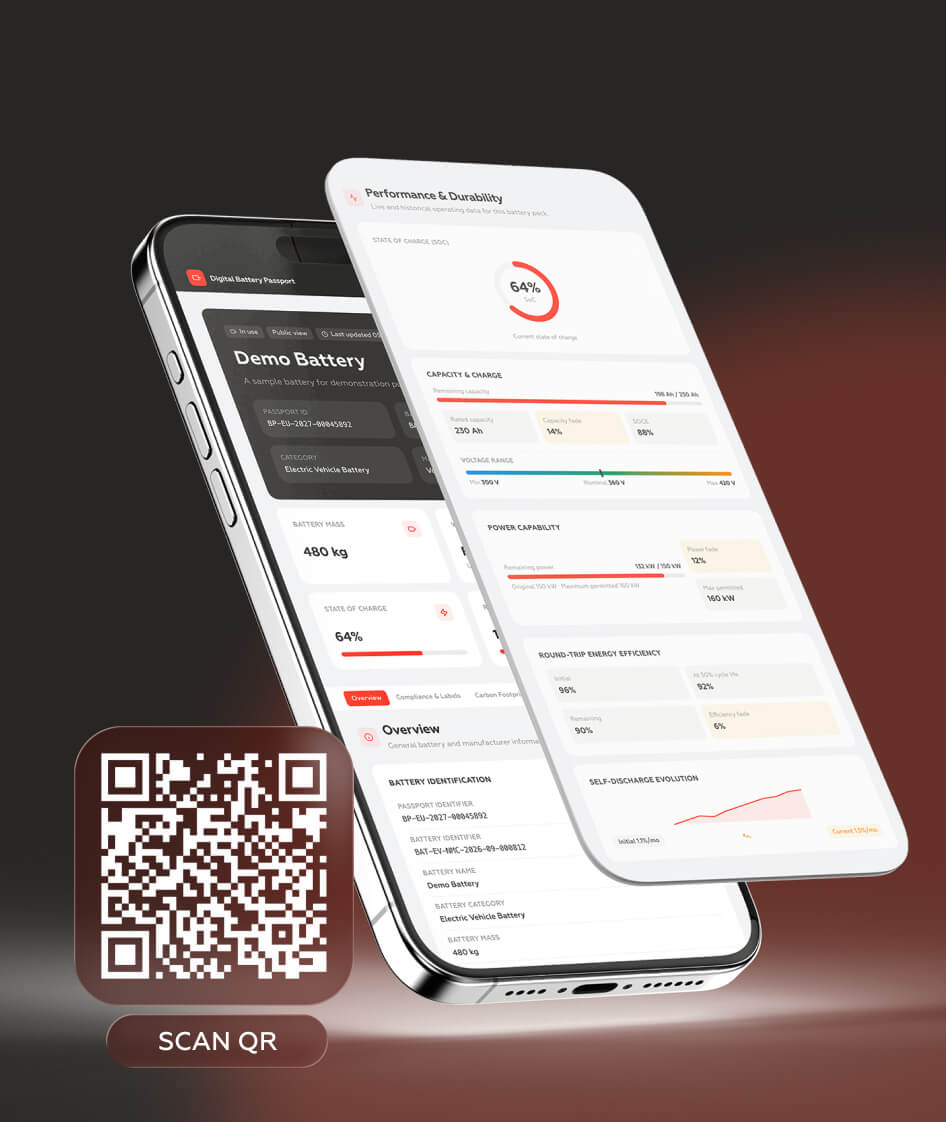
Demo Battery
A sample battery for demonstration purposes
Overview
General battery and manufacturer information.
Compliance & Labels
Regulatory symbols, safety and conformity documents.
Crossed-out wheeled bin
Separate collection symbol
Do not dispose with household waste. Return to authorised collection point.
Extinguishing agent
Class D dry powder / water mist according to safety sheet.
Challenges of DBP Implementation

Data Scattered Across Systems
A compliant digital product passport battery solution requires dozens of regulated data fields per battery — sourced from ERP, MES, PLM, BMS, and Tier-1 and Tier-2 supplier portals. Without a unified pipeline that pulls, transforms, and validates each field automatically, producing a compliant passport at production scale is operationally unworkable.

Data Confidentiality by Design
Under the EU Battery Regulation Digital Passport Framework, not all passport data is public. Proprietary formulations and commercial data must be protected while maintaining regulatory transparency — which requires a deliberate access architecture, not an afterthought.

Internal Capacity Constraints
Most manufacturers do not have the engineering bandwidth to build a DBP system from scratch alongside running production. The implementation timeline is 6–10 months, and the February 2027 deadline is fixed. Our DBP Accelerator compresses that timeline without requiring you to build the foundation from scratch.

Legacy Stack Complexity
Most manufacturers cannot replace their core systems. A DBP solution that does not integrate deeply with SAP, Oracle, or custom industrial stacks only creates another data silo — adding overhead without solving the compliance problem.
Start with our technical guide to DBP data infrastructure
Download Free Guide
What You Gain with Our DBP Solution Accelerator

Pre-built data models, core modules, and integration patterns mean you’re not starting from scratch. Implementation timelines shrink without cutting corners on what the regulation actually requires.

The accelerator is built on tested patterns for scalability, security, and regulatory interpretation, so the system you go live with is the same one that passes an audit eighteen months later.

Reusable components and pre-configured connectors reduce custom development. You know what you’re spending before the build starts, not after it’s run over.

Data models, workflows, and reporting adapt to how your business actually runs, not the other way around.
With a few months required for a robust DBP implementation, you need to start no later than Q2–Q3 2026 to be ready. The window to act is now.
How We Help

DBP Architecture & Data Model Design
We design and implement a custom DBP data architecture tailored to your systems — defining the data model, API layer, battery identifier registry, and QR code generation. Each battery receives a unique, persistent identifier that complies with EU requirements. The architecture is built to accommodate evolving technical standards.

ERP, PLM, and MES Integration
Your core systems — SAP, Oracle, Siemens Teamcenter, or custom industrial platforms — stay in place. We build the integration layer that pulls battery data from each source, transforms it into the DBP data format, and keeps it synchronized as production runs. BMS connections are included where applicable.

Supply Chain Data Onboarding
We design the supplier data-collection architecture for your digital product passport battery data model — API-connected for data-mature suppliers and portal-based for those with limited capability. Tier-1 and Tier-2 supplier submissions are validated, reviewed for gaps, and fed directly into the passport registry without manual reconciliation.

Battery Analytics and Reporting
We structure lifecycle data into auditable carbon footprint reports and build State of Health tracking aligned to the regulation’s declaration requirements. The output gives your team both compliance-ready reporting and operational visibility into battery performance across the fleet.
QR-Code Passport Interface
We built a custom public-facing and regulator-facing passport interface — accessible via a QR code and aligned with the EU Commission’s technical specifications. Configurable confidentiality layers control which fields are publicly visible and which require authenticated access.
Secure Cloud Deployment
We deploy the DBP infrastructure to AWS, Azure, or GCP with IAM policies, encrypted storage, role-based access controls, and audit logging configured before go-live. Authorized stakeholders can access only the data permitted by their roles, and every access event is logged.
Our Capabilities
System Integration Engineering
We connect to ERP, MES, PLM, BMS, and supply chain platforms via REST, SOAP, GraphQL, OData, or EDI — handling schema mapping, data transformation, and synchronization logic.
Data Pipeline and Analytics Engineering
We build ETL and ELT pipelines that move battery lifecycle data from production systems and supplier feeds into a structured, validated data model. Data quality checks, lineage tracking, and audit logs are built into the pipeline.
AI and ML Development
Our ML engineers build and deploy production models for State of Health estimation, predictive maintenance, anomaly detection, and lifecycle analytics.
Cloud Infrastructure and DevSecOps
We design and deploy secure, scalable cloud environments on AWS, Azure, and GCP — covering API gateways, managed databases, role-based IAM, network segmentation, audit logging, and GDPR-compliant data handling. Security architecture is defined at design time.
Business Analysis and Regulatory Mapping
We translate EU Battery Regulation requirements into engineering specifications. This produces unambiguous data schemas, system requirements, and acceptance criteria that the development team works from directly. Technical standards are still being finalized — the architecture we design accounts for that from the start.
What Our Clients Say About Us
They come up with lots of scalable and best-practice ideas that enable us to achieve what we have right now.

Crunch-IS was great at leading us on what good should look like and bringing our ideas to life for evaluation and review.

Crunch-IS impressed me with is the quality of developers. It is simply much better than in any other company we’ve tried working with.

We are impressed with their performance, how they are engaged with product development, and how they care about the product.

It’s been a very enjoyable experience. All has been fantastic about communicating, and working.

Our partnership with Crunch-IS has been an invaluable resource as we’ve scaled.

What I found in Crunch-IS was the technical competency, ability to think outside the box, and very good English.

They have a large impact on the whole architecture we ended up with. Overall, I’ve been pleased and impressed with everything Crunch-IS did for us.

Crunch-IS impressed us with their technical excellence and the sheer ‘meeting of minds and cultures’ and open, honest exchanges. This was not a decision we took lightly, and 5 months into the engagement we continue to be really impressed with how Crunch-IS approach the collaboration, and we’re delighted with the calibre of the team we have working with us.

Working with Crunch-IS was easy. They were patient with us as we worked through the contract questions and patient again as we were getting our billing set up. The design work was elegant and the developer delivered the app we had contracted for on time and good quality.

The team at Crunch-IS was very nice to work with. They worked diligently and were very professional. When questions or technical problems arose, they answered them quickly and were always ready and kind about helping us.

Crunch-IS developer helped us deliver an important feature for our project much faster than expected.

Crunch-IS facilitated a seamless, collaborative effort throughout the project. The team maintained open lines of communication, kept detailed records of task assignments, and adhered to project timelines. Their expertise regarding both design and development sets the company apart.

Crunch-IS provides ongoing development support that meets project requirements as needed. Despite their offshore location, they are easy to work with and accessible through communication channels

The best vendor we could possibly find. Crunch-IS blends practical development with innovative design principals. Internal and external feedback to app development has been positive. They complete project milestones by the planned schedule and deliver within budget. The team’s responsive and willing to engage in productive dialogue.

Crunch-IS exceeded my expectations. I appreciated the developers’ resourcefulness in the face of constraints and complex requirements. The company able to deliver and complete the project successfully.

The project has gone smoothly so far. Crunch-IS has an exceptional work ethic. Consequentially, they’ve been able to tackle every challenge that comes their way. They manage day-to-day work on their own well but also communicate with us regularly to make sure we’re on the same page.

The app Crunch-IS worked on is clean, streamlined, and functions as intended. Crunch-IS goes above and beyond to ensure that both teams are in tune. The passionate team crafts an enjoyable experience through their positive demeanor and effective project management skills. The team was very friendly, and working with them was a pleasure.

Why Choose Crunch-IS as Your Partner

Engineering Depth
We integrate directly with legacy ERP, PLM, MES, and BMS systems including custom industrial stacks and deploy DBP infrastructure to AWS, Azure, or GCP at production standards. Every integration is built for your specific system versions and data structures, not a generic connector.

AI-Accelerated Engineering
We apply generative AI throughout the DBP accelerator build, compressing delivery timelines without cutting scope. For DBP, where the compliance window is measured in months, faster engineering delivery is a material advantage.

Compliance Readiness, Then Execution
Compliance Consulting at Crunch-IS is always paired with the engineering capacity to deliver. The Compliance Readiness assessment identifies gaps, and the same team closes them.
Digital Battery Passport Solutions FAQ
Which types of batteries require a battery passport?
Under EU Regulation 2023/1542, the battery passport applies to electric vehicle (EV) batteries weighing more than 25 kg, light means of transport (LMT) batteries (e-bikes, e-scooters), and industrial batteries with a capacity greater than 2 kWh. Portable batteries and standard starting-lighting-ignition (SLI) batteries are not subject to the same requirements.
How does the Digital Battery Passport relate to the Digital Product Passport?
The Digital Battery Passport is the first mandated implementation of the broader Digital Product Passport (DPP) framework under the EU’s Ecodesign for Sustainable Products Regulation (ESPR). It establishes the data architecture and interoperability standards that will extend to other product categories — making it the reference case for DPP compliance across industries.
What is the regulatory timeline for the EU Battery Passport?
EU Regulation 2023/1542 entered into force in August 2023. Carbon footprint declarations became required from February 2025. QR code labeling linking to carbon footprint data is required from August 2026. Full battery passport compliance — covering composition, State of Health, carbon footprint, due diligence, and recycled content — is mandatory from February 18, 2027.
What if a non-EU manufacturer (e.g., a Chinese manufacturer) sells batteries in Europe?
The regulation applies to any battery placed on the EU market, regardless of its place of manufacture. Non-EU manufacturers must meet all DBP requirements before their products can enter Europe. Compliance responsibility typically falls on the EU-based importer or authorized representative if the manufacturer has no EU entity.
What happens if a company does not comply with DBP requirements?
Non-compliant batteries cannot be placed on the EU market from February 2027. Consequences include significant financial penalties and market access restrictions. Non-compliance may also affect OEM contracts and supply chain relationships beyond direct regulatory penalties.
What specific information needs to be included in a battery passport?
Required data fields include:
- unique battery identifier,
- manufacturer details and product specifications,
- material composition, including hazardous substances and recycled content percentages,
- carbon footprint data across the lifecycle,
- State of Health and performance parameters,
- supply chain due diligence data for critical raw materials (lithium, cobalt, nickel), and
- end-of-life handling and recycling instructions.
Delegated acts under the regulation are still being finalized and will specify exact data formats.
When should companies start preparing for battery passports?
Now. Custom DBP implementations require 6–10 months of engineering work — data architecture design, system integration, supplier data onboarding, and compliance validation.
Companies that wait until mid-2026 risk missing the February 2027 deadline. Starting with a compliance gap assessment provides time to identify data deficiencies, align suppliers, and build a reliable system without compressing the delivery timeline.
What is a Digital Product Passport?
A Digital Product Passport is a structured digital record capturing a product’s material composition, manufacturing data, performance parameters, and end-of-life information — linked to a unique product identifier.
Under EU regulations, DPPs are designed to make this information accessible and machine-readable across supply chains, enabling circular-economy practices and regulatory compliance. The Digital Battery Passport is the first mandatory product category under this framework.
Tell Us What You’re Building
Send an outline, a spec, or three sentences about where the system has stopped. One conversation is usually enough to know whether we’re the right fit.
Custom software, AI & ML, data and analytics, cloud, and security — from early scoping to long-term delivery.
- 170+ experts
- 120+ delivered projects
- 97% fully satisfied


